
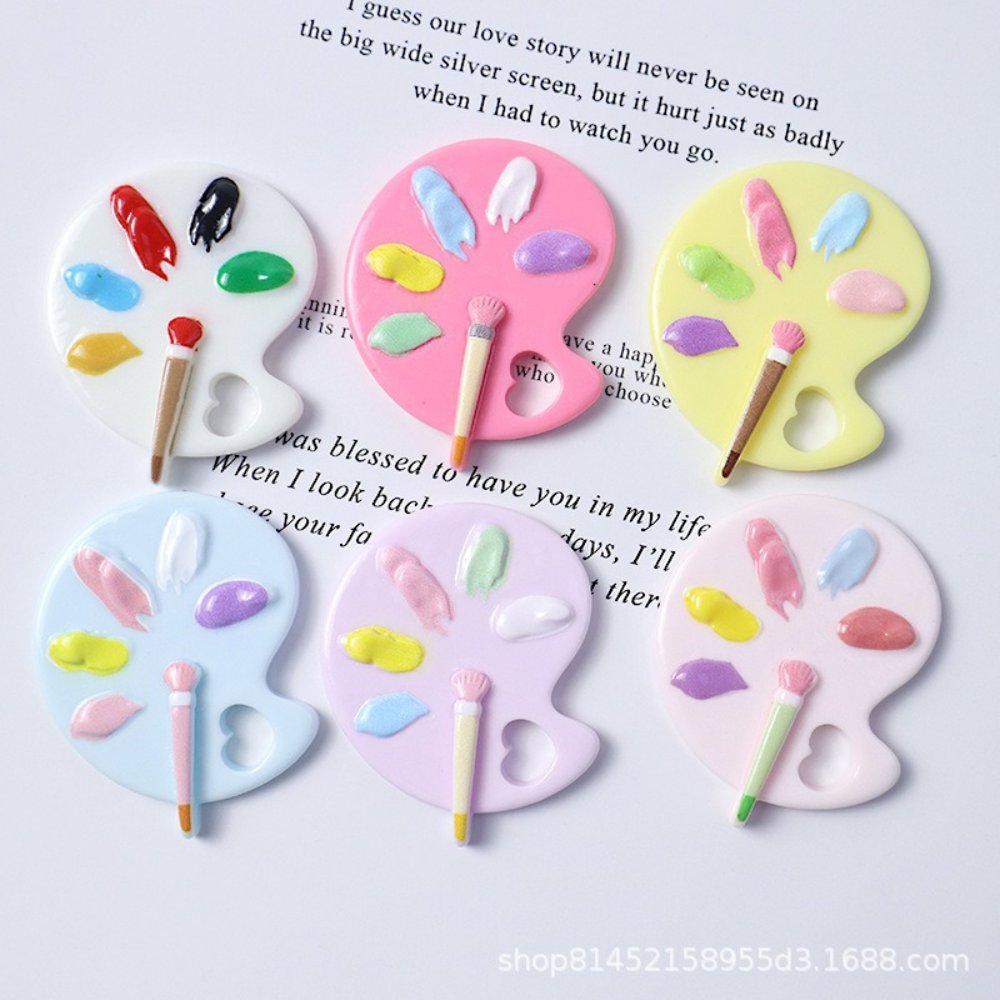
Palette Charm RFQs: Map the Decorative Components
For decorative palette charms, ask the supplier to identify the palette-shaped base, brush motif and raised colour details in a component map. Clarify which visible features belong to the supplied ornament and whether the manufacturer describes them as one formed piece or an assembled construction. Keep that answer tied to the exact offered design. Catalogue styling does not establish functional painting use, detachable accessories or the material composition of every visible feature.
Supplier-published catalogue reference. Styled props and advertising statements do not establish commercial inclusions, a construction detail or an independently verified performance result.
Identify the decorative palette product
Chengyue publishes Resin Palette Charms in its jewelry-accessory catalogue. The official gallery shows miniature palette-shaped decorations with raised colour marks and a brush-shaped motif. These are product appearance references for a decorative charm enquiry. They should not be described as working painting palettes, supplied paint, cosmetic applicators or a particular finished jewellery attachment that the listing does not confirm.
Use the official Resin Palette Charms page to identify the item. Ask the supplier to confirm which design and version its quotation covers. The visible range includes different colour appearances, but the component enquiry should first name the actual selected ornament. Keep that product reference alongside any buyer annotation so a marked image can be traced back to the supplier offer.
Make a region map of the visible features
Request a supplier-marked view naming the palette-shaped base, brush-shaped feature and raised decorative areas. Let the manufacturer provide its own component or region terms. A buyer can use neutral location labels to ask the question, but should not assume that every differently coloured area is a separately manufactured part. The shape of an apparent join in a catalogue photograph is not enough to establish an assembly method.
Ask whether the offered decoration is described as one formed piece, an assembly or another specified construction. Keep the supplier explanation with the marked reference. Where a feature is separate, ask how it is identified in the manufacturer record; where it is integral, record that statement for the selected version. Do not invent an adhesive, fastening method, moulding process or material formulation from the visible appearance.
Supplier-published catalogue reference. Styled props and advertising statements do not establish commercial inclusions, a construction detail or an independently verified performance result.
Separate included features from styling props
Clarify whether the brush-shaped motif forms part of the supplied ornament and whether any pictured objects are only photographic props. A book page or background surface is part of the catalogue composition, not an order component. Likewise, several charms shown together do not by themselves define the contents of one commercial unit. Keep the component map about the selected ornament and ask the supplier to identify any separate supplied item explicitly.
Do not use the component map to assume that a visible feature is removable or intended for handling as a separate accessory. If the intended application requires that distinction, request a direct manufacturer response. A decorative brush outline is an appearance element; it should not become an advertised working brush. The supplier should confirm the construction and supplied scope without a buyer filling gaps from products with superficially similar shapes.
Buying field
Requested supplier response
Product reference
Selected Resin Palette Charms design and offer
Base region
Supplier name and marked palette-shaped area
Brush motif
Manufacturer description and included scope
Raised details
Named regions and component relationships
Construction
Supplier-confirmed integral or assembled description
Supporting reference
Marked image, drawing or actual sample identifier
Changes
Revised design and component explanation kept together
Keep material and application questions scoped
The product title uses a resin description. That title does not identify the formulation of every region or establish the suitability of the ornament for a particular finished application. If a component-specific material statement is needed, request it from the supplier for the named feature and offered version. Keep its scope explicit rather than copying an unrelated cabochon material statement into this palette enquiry.
If the buyer plans to incorporate the ornament into another item, keep the finished-application requirements in a separate record. The component description can help identify what will be evaluated, but it does not establish an attachment rating, a child-safety result or compatibility with a particular production process. Any required assessment should have a defined scope and actual evidence. Do not convert the gallery presentation into an unsupported end-use promise.
Supplier-published catalogue reference. Styled props and advertising statements do not establish commercial inclusions, a construction detail or an independently verified performance result.
Link the actual sample to the component record
When a sample is received, record its product and design reference before comparing its visible regions with the supplier map. If a feature differs, mark the location and ask the supplier to explain the version difference. Keep a changed colour appearance, an absent decorative feature and a different construction statement as separate observations. A precise question is easier to resolve than a general complaint that the charm does not match the picture.
Before ordering, retain the accepted component explanation, marked image and supplier offer together. Ask the supplier to identify later construction changes instead of relying only on an unchanged product name. This provides a useful procurement record for the actual decorative palette charm while avoiding invented assembly methods, detachable-part claims or functional painting descriptions. The final order should describe what the manufacturer has confirmed, with unresolved application questions still visible.
Buyer FAQ
Are the pictured colour marks supplied paint?
The gallery presents decorative palette charms. Do not describe the raised colour details as usable paint without an explicit, supported supplier statement.
Is the brush motif a separate accessory?
Ask the supplier to confirm its construction and included scope for the exact design. A visible brush-shaped feature does not establish that it is detachable or functional.
Does the component map prove end-use suitability?
No. It identifies the offered ornament. Any required assessment of a finished application needs its own defined scope and actual evidence.
Supplier response checklist
Exact offered product, component and version references
Supplier-marked description and identified sample scope
Confirmed statements separated from pending questions
wholesale jewelry accessoriesB2B supplier sample record